Orchestrating Value Creation Systems
The Left-Shift from Product Management to Strategic Orchestration


Introduction
As AI capabilities move upstream in the product lifecycle, the role of product management is undergoing a fundamental transformation. In the AI-infused Product Lifecycle described in the first article, core execution has become increasingly automated and accelerated, with many aspects of building and decision validation now handled by intelligent systems.

This evolution means product leaders must shift their focus leftward: from managing backlogs and delivery to orchestrating strategy, systems, and the collective efforts of humans and AI towards a desired outcome. In other words, the product manager becomes less of a project manager and more of a chief orchestrator of value creation across a complex network of tools, data, and teams.
What does this look like in practice? Traditional product management often centered on tasks like writing feature specs, prioritizing stories, coordinating between design/ engineering/ marketing, and pushing products out the door. In an AI-driven environment, many of those tasks are handled by intelligent systems or significantly augmented by them. The new challenge (and opportunity) for PMs is to integrate and align all the moving parts – human and machine – toward the product vision. This involves defining high-level intent, shaping the problem space, and enabling autonomous agents (human or AI) to execute effectively. It’s a role that combines strategy, systems thinking, and leadership.
As one framework puts it, product managers are evolving into “architects of intent” and “orchestrators of distributed cognition,” rather than ticket triagers or meeting facilitators.
This shift is not just about tools; it’s also cultural. AI makes previously hidden insights visible and breaks down silos of information. Decisions can be more data-driven and transparent, reducing the need to rely on hierarchy or gut feel. Collaboration starts to revolve around shared AI-generated evidence instead of opinion battles. Organizations embracing this see trust increase (because decisions are backed by data everyone can see) and execution accelerate (because teams rally around a clear, data-informed direction rather than waiting for top-down directives).
In this article, we’ll delve into five core shifts in the product manager’s responsibilities in an AI-driven context, illustrating how the role expands into orchestration. We’ll then discuss the strategic and organizational implications of this new operating model. By understanding these shifts, senior product leaders and executives can better prepare their teams (and themselves) for the next stage of the AI revolution: one where success depends less on managing tasks and more on designing the right system for value creation.
From Product Manager to Strategic Orchestrator
When execution is largely handled by autonomous systems and agile teams empowered by AI, the product leader’s value-add moves to higher-level coordination and system design. A useful analogy is moving from being a conductor of a symphony (ensuring each section plays its part on cue) to a composer and orchestra architect (deciding what music to play, assembling the right performers and instruments, and ensuring they’re in harmony). Let’s outline the five key shifts happening to the PM role:
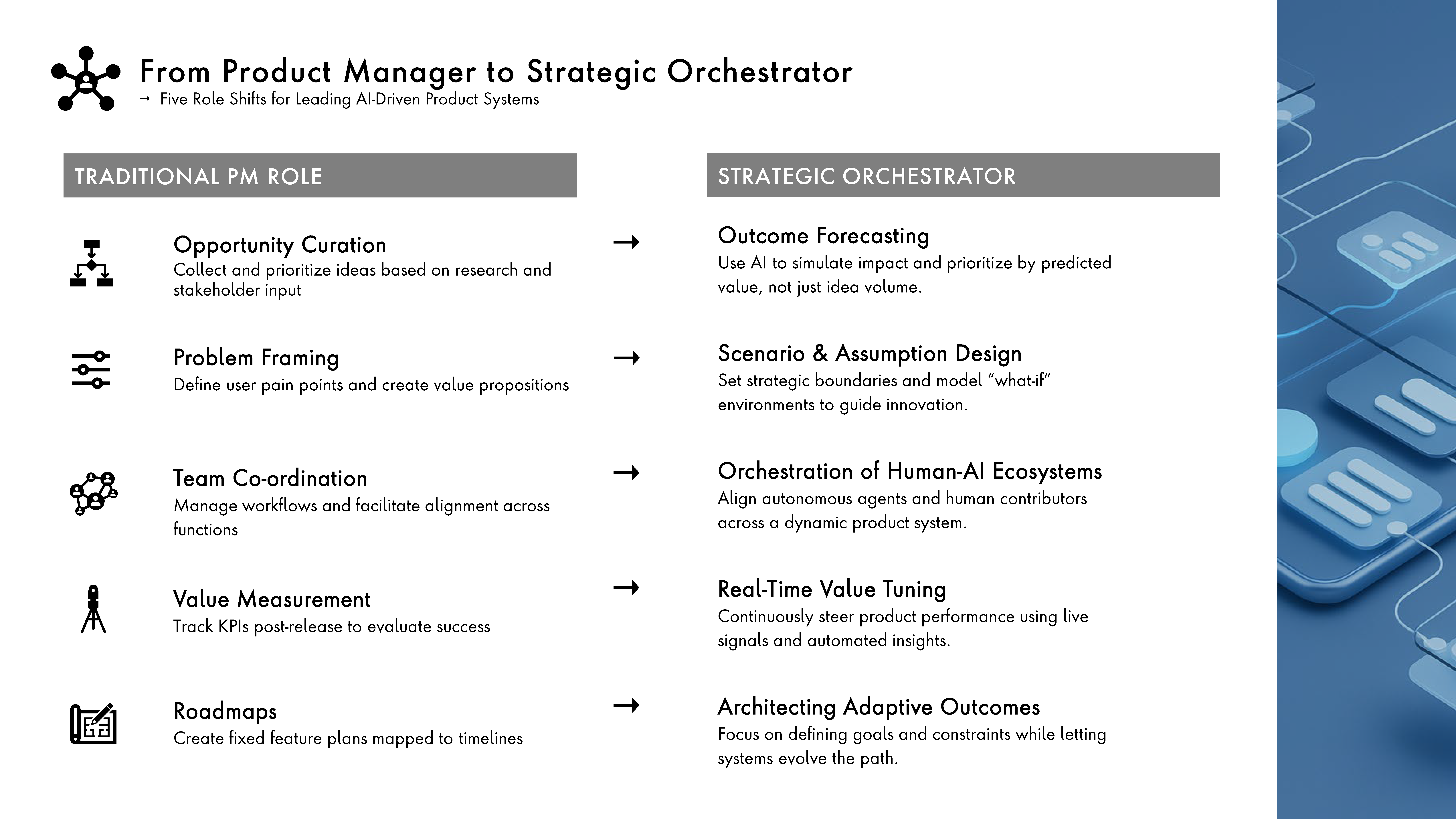
1. From Opportunity Curation ➝ Outcome Forecasting
Old Role: Collect ideas from customer research and feedback, then select which ones to pursue. The PM acted as a curator of feature ideas or product initiatives – deciding, often qualitatively, which concepts made it onto the roadmap.
New Role: Use AI to evaluate future outcomes through simulation and pattern recognition, selecting initiatives based on their projected impact on key business metrics and meaningful customer value. Product decisions are guided by which outcomes matter most to the user and align with long-term customer success. Instead of asking “which idea seems best?” the PM now asks “which potential product outcome is most valuable for us to pursue, and which idea gets us there?”
AI Enables: Pre-validation of opportunities. Using behavioral modeling and predictive analytics (like those described in the first article’s Strategic Positioning & Investment Prioritization activities), AI can project the likely impact of an idea on key metrics (conversion, revenue, retention, etc.). It can also dynamically score opportunities as new data comes in. This means a PM might have a dashboard that literally forecasts the possible lift in customer LTV if feature X is delivered, with a confidence interval, based on live data and models.
Strategic Outcome: The product manager’s role becomes guiding the team toward the most promising outcomes, not just assembling a backlog of interesting ideas. It’s a shift from idea-centric to outcome-centric. For example, rather than saying “Our priority is to build a new onboarding module,” an outcome-focused PM might say “Our priority is to increase 30-day user retention by 15%, and among several strategies modeled, improving onboarding flow has the highest likelihood to achieve that.” The entire conversation changes to outcomes and evidence, which aligns the team on why something matters, not just what to build.
2. From Problem Framing ➝ Scenario & Assumption Design
Old Role: Define the customer problem and craft a value proposition. PMs traditionally spend time understanding user pain points, writing problem statements, and specifying requirements that address those problems.
New Role: Design the strategic boundaries, scenarios, and constraints within which AI systems and teams operate: ensuring that exploration happens in service of real customer needs. The PM defines the conditions for innovation with a clear understanding of user context, priorities, and expectations. Instead of just articulating a problem, they set up the environment in which solutions will be explored (often by AI). For instance, a PM might establish: “We’re targeting this user segment, with these goals (e.g., reduce time to perform Task A), under these constraints (e.g., must uphold privacy standard X, budget Y), and these are the scenarios we’ll consider.” This is akin to defining the rules and parameters for a game, within which AI and the team can generate and test ideas.
AI Enables: Dynamic context calibration and risk modeling. With AI, PMs can quickly adjust assumptions and see implications. Want to test a scenario where the market suddenly shifts or a key partner API becomes unavailable? AI simulations can reveal how robust different solutions are to those changes. Also, AI can help enforce constraints- for example, automatically checking ethical or regulatory boundaries (say, if an idea drifts into using sensitive personal data, an AI can flag that as out-of-bounds). This capability turns the PM into a sort of systems engineer or game master, where framing a problem includes setting up adaptive experiments rather than one-and-done definitions.
Strategic Outcome: The PM becomes a system designer, not just a problem statement writer. They frame problems as multivariate models that AI and the team can explore. This means acknowledging uncertainty and creating multiple what-if paths upfront. The benefit is twofold: teams understand the context and purpose deeply (not just a narrow spec), and the strategy becomes resilient to surprises because you’ve already considered various scenarios.
3. From Team Coordination ➝ Orchestration of Distributed Human–AI Ecosystems
Old Role: Facilitate communication and alignment across functional teams (engineering, design, QA, marketing, etc.). A huge part of a classic PM’s job is coordinating meetings, ensuring everyone has the info they need, and resolving cross-team dependencies – essentially, being the hub in a hub-and-spoke model of team collaboration.
New Role: Coordinate a mix of autonomous AI agents, human specialists, and modular platforms across the product ecosystem. This is orchestration in the true sense: you might have an AI handling user segmentation, another AI personalizing content, a human UX designer creating a new prototype, and an external platform providing data – all of which need to work in concert. The PM’s role is to set objectives for each component and define how they interact. It’s less about telling people what to do each day and more about ensuring the system as a whole is aligned and functioning. For example, a PM might orchestrate an AI-driven marketing campaign launch to coincide with a feature release by setting up triggers and guardrails in the system, rather than manually emailing people to coordinate timing.
AI Enables: Intelligent task routing, translation of goals into tasks, and decision support across the ecosystem. AI can serve as the connective tissue between different actors. Suppose a PM sets a goal “improve signup conversion by 10%”. An AI orchestrator could translate that into sub-tasks: it might notify a design AI to generate variant landing pages, tell a data science AI to analyze which user segments drop off, and schedule a human copywriter (or copy-generating AI) to try new tagline variations – all in parallel, with minimal PM intervention. The PM oversees and adjusts objectives or parameters if needed, but the micro-coordination is handled by AI. Additionally, AI dashboards provide decision support: the PM gets real-time insights (e.g., which variant is performing best) to make high-level calls.
Strategic Outcome: The PM governs interactions and ensures intent alignment across a far more complex, distributed network of contributors. Think of it as moving from managing a single team to managing an ecosystem. The orchestrator PM ensures that each component (whether an AI service or a team) is working towards the same product vision and user intent, and that handoffs between them are smooth. This is crucial because as more AI agents come into play, the risk is that each optimizes for its own local goal (for instance, a recommendation algorithm maximizing clicks might conflict with a long-term user satisfaction goal). The orchestrating PM watches for these conflicts and adjusts the system to keep everything in balance with the overarching intent.
4. From Value Measurement ➝ Real-Time Value Tuning
Old Role: Define KPIs and use analytics dashboards to measure if the product is delivering the expected value after releases. Typically, a PM might wait for a post-launch period to gather data and then decide on course corrections.
New Role: Continuously tune product “levers” using live telemetry, user sentiment, and micro-feedback loops. Here, the PM works more like a pilot constantly adjusting controls based on instrument readings. Rather than reviewing metrics occasionally, they (often with the help of AI) tweak and optimize in near-real time. For example, if engagement in a certain funnel step drops this afternoon, the PM can deploy a quick change by evening (perhaps via an AI-driven experiment) to address it, rather than scheduling it for next sprint.
AI Enables: Predictive insights (like early churn detection) and automated UX optimization. AI systems can not only show what is happening, but also anticipate issues before they fully manifest. For instance, an AI might analyze patterns and warn, “Users who did X are likely to drop out tomorrow.” It could also suggest or even implement countermeasures, such as adjusting the difficulty of onboarding steps or offering a tailored incentive, then measure the effect. Additionally, AI can run continuous optimization of certain features – like automatically adjusting the layout or timing of notifications for each user to maximize engagement, within parameters the PM sets.
Strategic Outcome: The product manager’s mindset shifts from delivering value in chunks (with big releases) to maintaining an ongoing alignment between the product’s behavior and user expectations/value. Product leaders take an active role in managing and tuning value delivery using live data, rather than relying solely on retrospective metric reviews. In essence, the PM and their AI tools are steering the product in real-time, much like an autopilot system that keeps a plane on course, making tiny adjustments constantly. This leads to higher and more consistent user satisfaction because the product is always being fine-tuned to meet user needs. It also means issues are corrected faster, reducing negative impacts. For organizations, this approach can dramatically improve key metrics (conversion, retention, etc.) because you’re never “flying blind” – you’re always responding to signals.
5. From Roadmaps ➝ Architecting Adaptive Outcomes
Old Role: Own the roadmap – a sequenced plan of features and releases mapped to timelines. The roadmap is often static or only updated quarterly, and success is measured by delivering on this plan.
New Role: Architect a system for delivering outcomes, via adaptive experiences and feedback-driven services, rather than a static roadmap. In practical terms, this could mean the PM focuses on setting up goals and guardrails (the outcomes desired and boundaries) and then allows the system (comprised of AI and teams) to determine the exact features or changes needed to achieve those goals. The “roadmap” becomes more of a dynamic model or simulation that evolves as conditions change. The PM ensures the system is pointed at the right North Star (e.g., “make this product the most trusted solution for doing X, measured by NPS and retention”) and then curates what emerges, rather than dictating that “Feature A will ship in Q1, Feature B in Q2” regardless of feedback.
AI Enables: Outcome simulation and agent-guided adaptation. AI can help by constantly evaluating if the current trajectory of the product will meet the desired outcome and suggesting course corrections. For example, if the goal is to increase monthly active users by 20%, and current experiments show only a 10% lift, the AI might recommend exploring a different approach (perhaps an unplanned feature or an adjustment to pricing) by simulating its potential impact. In a way, AI agents can serve as co-strategists, highlighting where the current plan may fall short and where there are opportunities to exceed targets. This makes the planning process much more dynamic and evidence-based.
Strategic Outcome: The PM’s role becomes one of intent modeling and adaptive goal management. They ensure the product continuously evolves toward the desired outcomes rather than simply delivering a predefined set of features. The benefit here is flexibility and resilience: if a planned feature doesn’t have the impact expected, the approach is swiftly adjusted. The product strategy is no longer a static roadmap but a living strategy that can pivot as needed without losing sight of the end goals. It’s like steering a ship with real-time navigation – if the winds change, you adjust your sails and course, but you still aim for the same destination.
These five shifts illustrate the broad change: product managers in an AI-driven environment are moving from being doers and coordinators to being strategists, designers, and orchestrators. Let’s consider what this means in terms of day-to-day responsibilities and organizational perception of the PM role.
Strategic Implications of the Orchestrator Role
By embracing the orchestration mindset, product managers cease to be the overburdened “Jacks of all trades” responsible for every little detail. They are no longer simply:
The owners of backlogs or task lists.
The drivers of delivery schedules.
The managers of feature releases.
Instead, they become:
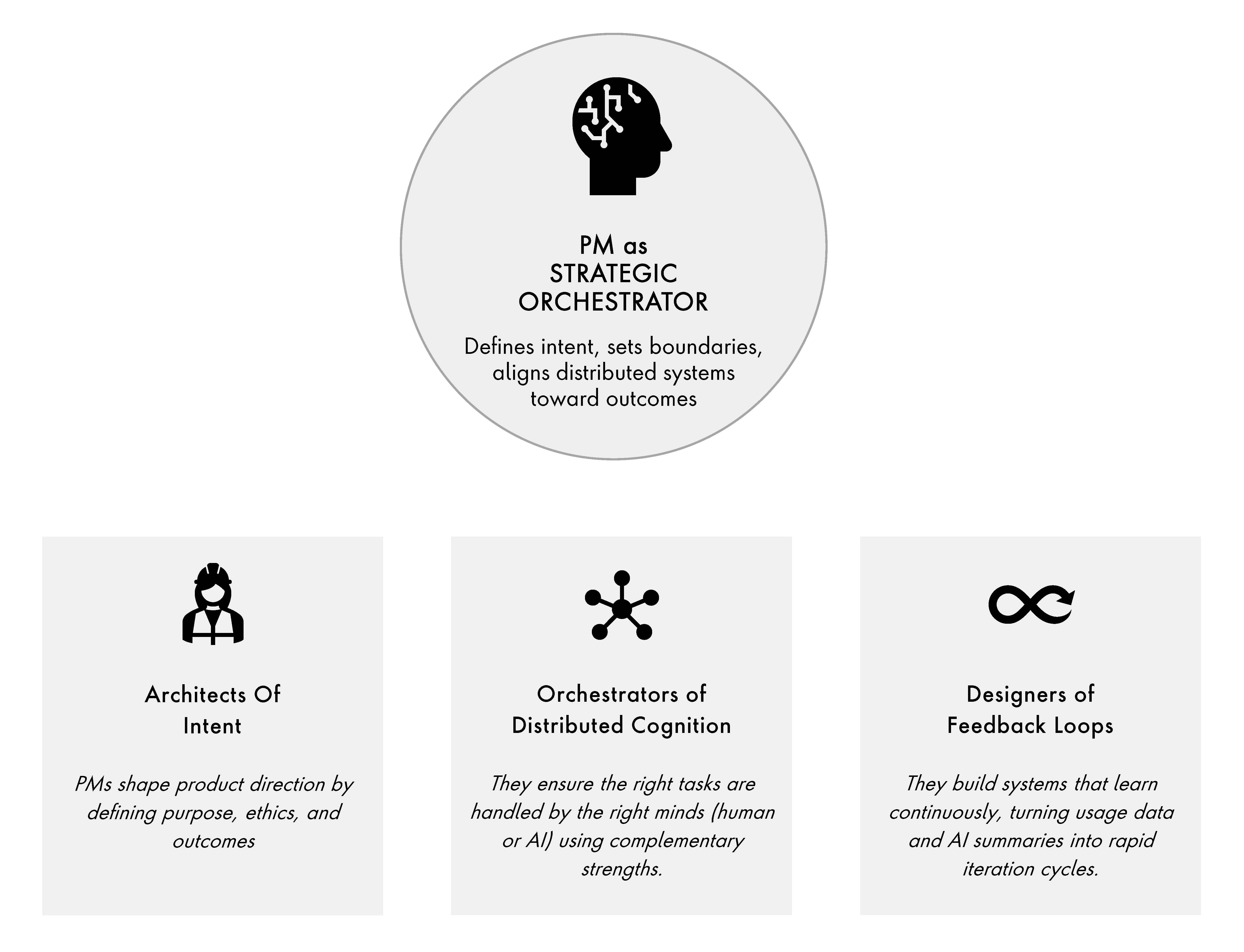
Architects of Intent: Clearly defining the purpose and goals that guide all product efforts. For example, setting the intent that “our product will prioritize user trust and data privacy above growth at all costs” and ensuring everything from AI algorithms to marketing messages align with that intent.
Orchestrators of Distributed Cognition: Leveraging both human expertise and AI intelligence throughout the product system to achieve goals. In practice, this might mean setting up processes where an AI identifies patterns and human experts provide context or creative solutions, each doing what they do best. The PM makes sure the right minds (artificial or human) are on the right problems.
Designers of Value Feedback Loops: Ensuring continuous learning by structuring how user feedback and data flow back into decisions. This could involve, for instance, implementing a loop where every feature release auto-collects user feedback, AI summarizes it, and a decision is made within days on whether to iterate further or pivot. The PM designs this loop so that the product constantly improves itself via feedback.
This shift in role has profound effects on how teams operate and collaborate. Some emerging patterns in organizations moving this direction include:
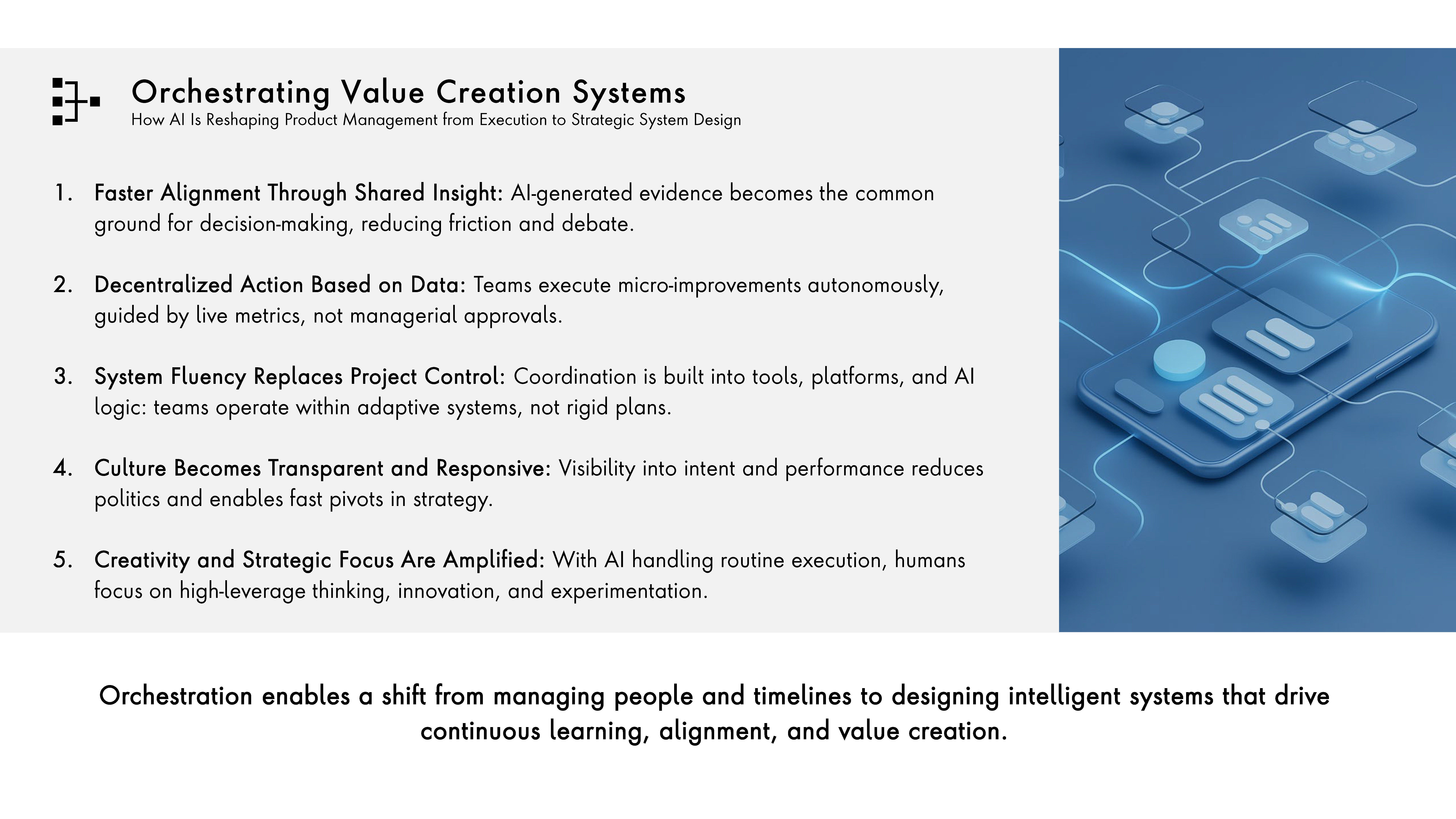
Faster Team Alignment: When the PM provides a clear intent and shared data context, teams spend less time in debate and more in action. AI-generated insights (like “this feature is driving 20% more engagement among cohort A than B”) give everyone a common ground of truth. Decisions that used to be contentious get resolved by looking at evidence, which the orchestrator PM ensures is accessible. As a result, teams align quickly around what needs to be done, rather than each function pushing its own agenda.
Data > Hierarchy in Decision-Making: The culture shifts to trust data over seniority or gut feel. When AI provides real-time metrics and analysis, even junior team members or AI agents can surface a direction that the whole team follows, because it’s backed by evidence. This reduces the over-reliance on managerial approvals for every decision. In practice, you might see teams rolling out micro-improvements autonomously because the data (monitored by AI and visible to all) shows it’s the right move, whereas in the past they’d wait weeks for approval.
Execution via System Fluency, Not Project Control: Because so much coordination is automated or built into the system, the need for rigid project management lessens. Teams that are fluent in the product’s systems and AI tools can self-synchronize. The PM doesn’t have to micromanage timelines; they focus on making sure the system (tools, data flows, communication channels) enables smooth execution. This is reminiscent of DevOps culture in engineering where continuous delivery pipelines automate the release process – here the entire product development and delivery is a pipeline that the PM oversees and tweaks for efficiency.
The net result is an operating model with more transparency, responsiveness, and creativity:
Transparency builds trust: When everyone can see the data behind decisions and the intent guiding actions, there’s less second-guessing. For example, if a decision is made to cut a low-performing feature, the team can see the usage data that led to it, rather than wondering if it was political. This openness fosters trust in leadership and across functions.
Responsiveness replaces rigidity: The organization can pivot quickly because it’s always sensing and responding, rather than sticking to a fixed annual plan. If a new user need emerges or a competitor moves, the orchestrator model with AI support allows a rapid reorientation, whereas a traditional model might be stuck with whatever was on the roadmap.
Human creativity is amplified: By relieving teams of routine coordination and analysis drudgery, everyone can contribute more creatively. Engineers can experiment with new technical solutions instead of doing repetitive merges; designers can try bold ideas informed by AI suggestions; PMs can spend time with customers and on vision. The orchestrator PM ensures that the environment is set up to elevate human creativity above mundane tasks, often by assigning those mundanities to AI.
In summary, orchestrating value creation systems is about creating the conditions for success – aligning people and AI to a common purpose, with the infrastructure to support continuous learning and adaptation. It transforms the product manager into a pivotal strategic role: the person who designs how the system works, not just what the system produces. This left-shift of focus earlier into problem-framing and ecosystem design is enabling some organizations to innovate faster and more reliably than their competitors.
The implications extend beyond the product team. When product management steps up to orchestration, it influences organizational structure and strategy. Companies may start to collapse silos, because an orchestrator role naturally works across traditional boundaries (product, engineering, data science, operations). New hybrid roles can emerge, like “AI product operators” or “systems architects” who maintain the AI-driven pipelines. Additionally, leadership expectations of PMs rise – they are seen more as mini-GMs of their product domain, responsible for end-to-end success, not just delivery. Interestingly, this aligns with observations from industry: with AI handling more execution, PMs finally have the capacity to fulfill the long-standing vision of being true product CEOs1, overseeing everything from ideation to adoption.
Orchestration is the new core competency for product teams in the AI era. Success depends less on managing tasks: and more on designing the system that creates value.
The article closes with a key realization: Orchestration is the new core competency for product teams in the AI era. Once teams have mastered speeding up the lifecycle (see previous article), the next differentiator is how well you can coordinate and leverage all the moving parts AI unlocks. However, as product leaders become great conductors of these complex systems, a new challenge appears on the horizon: what if you could not only orchestrate better in the present, but also pre-play the future? In other words, if you have a finely tuned orchestra, how do you decide what symphony to play next? This tees up the next evolution – leveraging AI to simulate and test multiple future product strategies before committing to one. As we turn to the next article, consider this question: What if you could explore a dozen potential futures for your product – and know which one will likely lead to the greatest success – before writing a single line of code? That’s the promise of simulation-led product strategy, our next focus in this series.
References
[1] McKinsey & Company, How an AI-enabled software product development life cycle will fuel innovation, 2023. [Online]. Available: here
All views expressed here reflect my personal perspectives and are not affiliated with any current or past employer. Portions of this article have been developed with the assistance of generative AI tools to support content structuring, drafting, and refinement.
Previous articles in this series:
Next articles in this series:
